



#News #Latest #trending #india

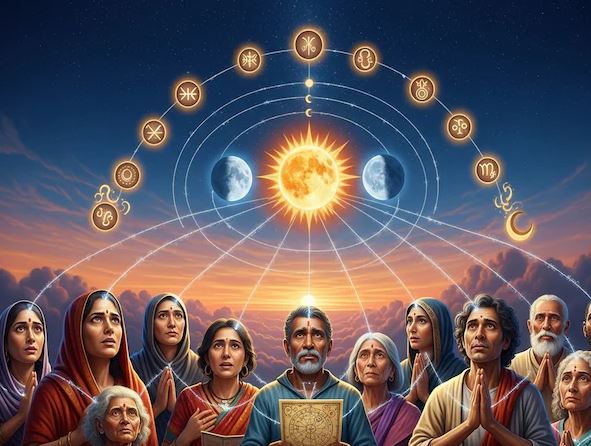
Looking at the night sky, a question often arises in the mind – we live on Earth, our daily worries, decisions and emotions are formed and undone here, then how can the planets moving millions of kilometers away affect our lives? Astrologers say that planets and stars are not just celestial bodies but sources of energy that influence the body, mind and destiny of humans. While science has a different perspective, some natural phenomena – such as the Moon’s effect on tides – make this discussion more interesting. The distance between the misconceptions and actual understanding about the Navagrahas still persists. So how can this relationship between planetary movements and human life be understood? This report seeks answers to this curiosity.
Balance of planetary energy and life
According to astrology, three main energies are considered necessary for life on earth – sound, heat and light. We get sound energy from the atmosphere and body activities, but humans are completely dependent on the sun for light and heat. This is the reason why the Sun is called the giver of life. In the tradition of astrology, the nine planets – Sun, Moon, Mars, Mercury, Jupiter, Venus, Saturn, Rahu and Ketu – are associated with different tendencies of human life. It is believed that the energy coming from these planets affects the biological and mental processes of the body. For example, Sun is associated with self-confidence and health, Moon with mind and emotions, Mars with blood and courage.
The waxing and waning light of the moon and the ups and downs of the mind
The Moon is the Earth’s nearest celestial neighbor, hence its influence is most discussed. Astronomical calculations show that the Moon moves closer or closer to the Sun by about 12 degrees every day. As it moves away from the Sun, its illuminated portion reduces and becomes almost invisible on Amavasya night. As the Moon comes closer to the Sun, it appears in full brightness on a full moon night. It is said in astrology that the more the moon’s light is reflected on the earth, the more its influence on man’s mind and behavior increases. Even today in rural areas, elders are found saying that they feel more restlessness, insomnia or emotional ups and downs during full moon days. There are differences of opinion on this in modern psychology, but this belief remains a part of popular belief.
example related to tides
The tides in the sea are linked to the gravity of the Moon – this is a fact proven by science. Based on this example, it is said in astrology that when the Moon can influence the waters of the vast ocean, then how can the human body – which consists of about 60 percent water – remain untouched by it. Based on this logic, the Moon is associated with the water element of the body and Mars with blood. It is said in astrological texts that the position of these two planets affects the health and mental state of a person.
Horoscope: Map of planetary positions
In astrology, horoscope is considered a kind of celestial map. The angle and direction in which the planets were at the time of birth is recorded in the horoscope. Each house is considered to be of 30 degrees, which shows the inclination of the planets and their relation to the Sun. It is believed that the more light or energy the planets reflect towards the Earth, the more “powerful” they are considered to be. For example, if the Moon is in a strong position at the time of birth, then the person is considered emotionally stable, whereas if the influence of Saturn is more then it is said that there will be increased struggle and discipline in life.
Although the scientific community considers it a symbolic or cultural belief, the importance of horoscope in social behavior continues even today – in marriage, career or even naming.
A mixture of belief, experience and perception
In a society like India, astrology is not just a medium for predicting the future but is a part of cultural tradition. Even today, farmers in villages observe the position of the moon at the time of sowing or harvesting. Many people start a journey, business or new work by looking at the “auspicious planetary position”. Pooja Sharma, an IT professional from Delhi, says, “I am not completely dependent on astrology, but sometimes taking decisions based on horoscope matching or planetary positions gives mental confidence.” This belief explains the social role of astrology – it is more of a psychological support than a scientific truth.
Misunderstandings and the need for balanced understanding
Many exaggerated beliefs have also spread about the influence of planets – like considering Saturn or Rahu as the cause of every problem. Experts say that it is not right to consider astrology as the final decision of destiny. The reality is that believing or not believing in the influence of planets is a matter of personal belief, but it is also true that celestial bodies like the Sun and the Moon have a physical impact on the Earth. The concept of astrology has developed amidst this reality and belief.
Symbolic relationship between sky and humans
After all, the relationship between planets and human life is determined not only by distance but by meaning. The planets moving in the sky make us realize the time, cycles and rhythm of nature. Whether it is considered to be the effect of energy or a cultural symbol, the concept of planets has been a part of human thinking and philosophy of life. Therefore, it would not be wrong to say whether the planets directly change life or not, but belief in them definitely affects man’s decision and outlook.