



#News #Latest #trending #india

Raipur : The Advanced Cardiac Institute (ACI) of Pt. Nehru Medical College and Dr. Bhimrao Ambedkar Memorial Hospital, Raipur has started the New Year 2026 with a historic achievement. Dean of Pt. Jawaharlal Nehru Memorial Medical College, Prof. Dr. Vivek Chaudhary said that in the year 2025, more than 2600 complex heart procedures were successfully performed by the Cardiology Department. Starting with just 41 cases in 2009, the department today performs more than 2000 advanced cardiac procedures every year.
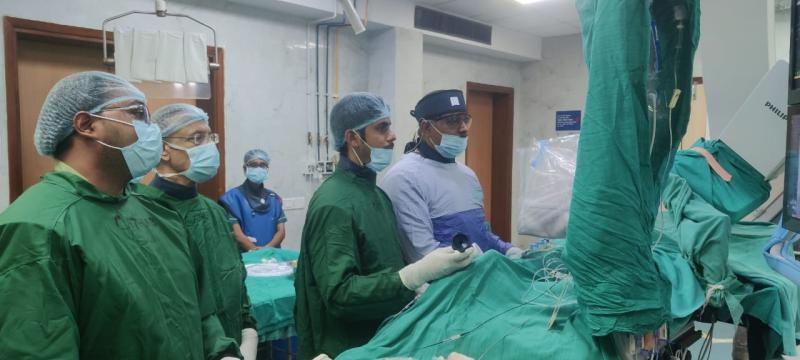
Dr. Smit Srivastava, Head of the Department of Cardiology, said that in the new year the department successfully performed a very complex Transcatheter Aortic Valve Implantation (TAVI) procedure. An elderly woman resident of Raipur was suffering from breathlessness and heart failure for a long time. Investigation revealed that his aortic valve had become completely hardened with calcium, due to which the pumping capacity of the heart was reduced to only 20 percent.
According to Dr. Srivastava, open heart surgery at this stage was extremely risky and almost impossible. In such a situation, the team of the Cardiology Department under the leadership of Dr. Smit Srivastava and the ‘Heart Team’ under the leadership of Dr. Krishnakant Sahu, Head of the Department of Cardiac Surgery, jointly formed the decision to do valve transplantation through the vein of the leg without any incision.
Preparations for the procedure began a month ago with special CT scan analysis and financial approval under the Chief Minister Special Health Assistance Scheme. The investigation also found that the patient’s leg veins were thin and calcium-rich, making it extremely challenging to deliver the valve delivery system to the heart. Also, due to a congenital structural anomaly, the coronary arteries of the heart were very close to the valves, which posed a serious risk of occlusion of both arteries during valve implantation.
To deal with this complication, experts inserted stents in both the coronary arteries and created a “chimney” structure between them and the valve. In the final stages of the procedure, a blockage occurred in the vein in the left leg during valve delivery, which was immediately reestablished by balloon angioplasty via the right leg.
After this complex procedure which lasted for about four hours, the pressure of the patient’s aortic valve reduced from 80 to zero on the operation table itself and the pumping capacity of the heart increased from 20 percent to 60 percent. The blood flow in both the coronary arteries remained normal and the heartbeat remained completely stable.
Hospital Superintendent Prof. Dr. Santosh Sonkar congratulated the cardiology team for ensuring availability of all necessary resources for this complex procedure.
This process was done by Dr. Shivkumar Sharma, Dr. Kunal Ostwal, Dr. Prateek Gupta, Dr. Soumya, Dr. Vaibhav and Dr. Prince under the leadership of Dr. Smit Srivastava. Cathlab technicians Jitendra, Badri, Premchand and staff nurses Anand, Digendra and others had important contributions in the team. Cardiac anesthesiology specialist Dr. Balswaroop Sahu and Dr. Sankalp Dewan also had special support.
Presently the patient has received recovery from the Heart Command Center and has been discharged to her home. The patients and their families expressed gratitude towards the ACI team, hospital management and Chhattisgarh government and reinforced their faith in the government medical institutions.
Complications in the case, lives saved by accurate decisions:-
The pumping capacity of the heart is only 20 percent – open heart surgery is extremely risky and almost impossible, so the decision was taken to undergo valve implantation (TAVI) through the leg vein.
The veins in the legs are extremely thin and weak.
In the past, special CT scan analysis was done and thinner and advanced delivery systems were used.
Decrease in height of coronary arteries-
Due to the risk of vein occlusion during valve implantation, a “chimney” structure was created by placing a stent.
Blockage in leg vein after procedure-
Blood flow was restored in the affected vein by immediate balloon angioplasty.
Possibility of untoward incident during the process-
From security point of view, the open heart surgery team was kept on standby.
Possibility of irregular heartbeat – Backup of temporary pacemaker ensured for 24 hours.
Possibility of complications after the procedure-
The patient was kept under intensive observation at the Heart Command Centre, where tele-monitoring was done through remote viewing technology.